Nice Education · CP · CM1 · CM2

Master French Verb Conjugation

Master the building blocks of communication

Make French verb conjugations easier to understand and remember.

Choose the French verbs and tenses you want to practise. See how endings change, compare tenses side by side, repeat the forms aloud, build each conjugation with a letter keypad and put your knowledge to work in sentences.

A structured progression with immediate feedback, progressive hints and clear results. Choose the material relevant to CP, CM1 or CM2, with real French examples throughout.

French Verbs

For Android tablets and mobile phones

  • Free
  • No adverts
  • No account
  • Works offline

French national curriculum · 2026–2027

Built around the CM1 and CM2 conjugation programme

French Verbs covers the conjugation tenses and core verb sets specified for CM1 and CM2. For CP, start with a deliberately smaller selection.

Start here / Core for CP

CP — Start simply

Tenses
Present only

Verb choices
Important verbs: initially select être and avoir only.

Optional early practice: simple standard -er verbs once your child is comfortable. This is pattern exploration, not a CP requirement.

Essential / Core CM1 practice

CM1 — Build the core

Tenses
Present · Imperfect · Simple future · Perfect tense (passé composé)

Verb choices
Important verbs · Regular -er · Regular -ir

Work on first-group spelling and stem changes. Extra irregular families are optional extension practice.

Consolidate CM1, then add two tenses

CM2 — Complete the progression

Tenses
Keep all four CM1 tenses and add Past historic (passé simple) and Pluperfect (plus-que-parfait).

Verb choices
Continue the same core verb sets: Important verbs, Regular -er and Regular -ir.

Additional irregular families are optional enrichment, beyond the named core list.

How it works

Learn → Repeat → Test

First look at how a verb works, then say it yourself, and finally try without the answers. Your child can follow the whole journey or return to the part they need.

  1. Learn

    Look at the conjugation together. Spot what changes and see how the verb fits into a French sentence.

    A little understanding before practice begins.

  2. Repeat

    Say each form aloud before it appears. Hearing it in your own voice helps make the pattern familiar.

    Build confidence, one form at a time.

  3. Test

    Have a go without the answers in front of you. See what you remember and what deserves another look.

    A chance to put that learning to work.

Choose what to study

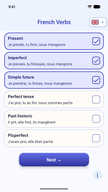
Choose tenses

Start with the tense your child is learning at school, or choose a few to practise together. You can add more when they feel ready.

Select the French verb tenses to study

Choose verb types

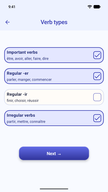
Next, choose the kind of verbs you want to study: Important verbs, Regular -er, Regular -ir or Irregular verbs. The CP, CM1 and CM2 suggestions above can help you decide where to begin.

Choose important, regular and irregular verb types

Choose individual lessons

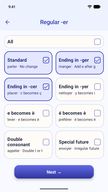
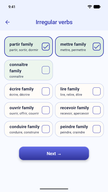
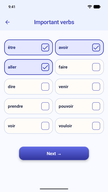
Within a verb type, you can choose particular verbs, patterns or families. It is an easy way to focus on what is being covered at school, with extra irregular families available when you want to go further.

Choose regular -er spelling patterns
Choose additional irregular verb families
Select individual important verbs, including être and avoir

The app remembers your last selection

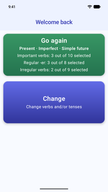
When you return, the app remembers the study set you completed last time. Carry on with the same choices, or change them before you start practising.

Welcome back: resume the saved selection or change it

Now go to Learn, Repeat and Test

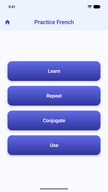
Your study set is ready! On the Activities screen, Learn helps you understand the pattern and Repeat helps you say it aloud. Then test yourself in two ways: Conjugate the complete verb, or Use the correct form in a sentence.

The Activities screen: Learn, Repeat, Conjugate and Use

Learn how the pattern works

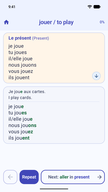
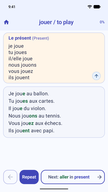
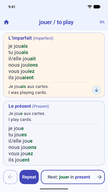
Start with a verb and tense from your study set. Look through the complete conjugation: je, tu, il/elle, nous, vous and ils/elles. The changing part is highlighted in green, so you can spot the pattern.

The small round button lets you move between the forms and examples. Read the sentences, then compare tenses when they appear together. Seeing the verb in use helps the forms make sense.

Take your time. Move through the lesson at your own pace, or choose Repeat when you are ready to say this verb aloud.

Repeat — say it, then check it

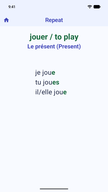
The app takes you through the conjugation one form at a time, leaving you a moment to say each answer aloud before showing it. Try saying it just before it appears.

At the end, the complete conjugation stays on screen. Look over it for as long as you like, then choose Next when you are ready to carry on.

Just you and the words: no speech recognition, microphone access or voice recording. The app does not listen to your child.

Repeat: forms appear progressively

First practice conjugating the verb

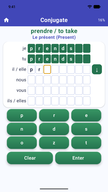
Now try building the conjugation yourself. In Conjugate, the app gives you a verb and tense, and you work through each form using the letters on screen. If you have chosen lots of verbs, you can focus on a smaller set before you begin.

If you make a mistake, try again. After a second mistake, a hint helps you find your way to the answer. Each correct form stays in place as you move on.

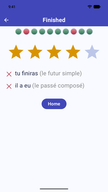
At the end, see how you did, earn up to five stars and go back over any forms that caused trouble.

Build prendre one form at a time

Next try using it in a sentence

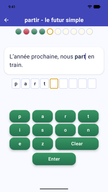
Once the conjugation feels familiar, try choosing the right form in a sentence. In Use, read each French sentence, work out which form belongs in the gap and build your answer on screen.

There are ten questions, with different subjects and situations, using your chosen verbs and tenses. The verb and tense are shown above the sentence to help you get started.

You find out straight away how you did. If you get stuck, hints help you move forward. At the end, review the answers that were difficult and see how many of the five stars you earned.

Use: complete a sentence with partir in the simple future

Your curriculum settings, in detail

CP — Start simply

Essential tenses
Present only
Essential verb choices
Important verbs: initially select être and avoir only.
Useful practice and optional extras
Optional early practice: simple standard -er verbs once your child is comfortable. This is pattern exploration, not a CP requirement.

CM1 — Build the core

Essential tenses
Present · Imperfect · Simple future · Perfect tense (passé composé)
Essential verb choices
Important verbs · Regular -er · Regular -ir
Useful practice and optional extras
Work on first-group spelling and stem changes. Extra irregular families are optional extension practice.

CM2 — Complete the progression

Essential tenses
Keep all four CM1 tenses and add Past historic (passé simple) and Pluperfect (plus-que-parfait).
Essential verb choices
Continue the same core verb sets: Important verbs, Regular -er and Regular -ir.
Useful practice and optional extras
Additional irregular families are optional enrichment, beyond the named core list.

In CP, classroom work begins with the subject–verb relationship, observation of frequent regular forms and using être and avoir in the present indicative in writing. The app’s CP starting selection supports that limited conjugation goal.

Important verbs — the essential CM1 and CM2 set

être · avoir · aller · faire · dire · venir · prendre · pouvoir · voir · vouloir

This category brings together être and avoir plus the eight irregular third-group verbs named in the CM1 programme. Continue this same core set in CM2, including the two additional tenses.

Regular -er → first group; Regular -ir → second group

Both groups are core CM1 practice and continue in CM2. The app shows examples such as parler, manger and commencer for Regular -er, and finir, choisir and réussir for Regular -ir. These are examples, not an exhaustive verb dictionary.

First-group spelling and stem patterns

The CM1 programme highlights mute e / é before the ending and patterns in -yer, -eler/-eter, -cer and -ger. After the Standard starting pattern, the six corresponding practice families below help explore those changes.

Standard — parler
No change: the starting pattern.
Verbs ending in -ger — manger
Add e after g where needed.
Verbs ending in -cer — commencer
c becomes ç where needed.
Verbs ending in -yer — nettoyer
y becomes i in the relevant forms.
e becomes è — lever
Notice the stem-vowel change.
é becomes è — préférer
Notice the accent change in the stem.
Double consonant — appeler
Practise consonant doubling within -eler/-eter patterns.
Special future — extension — envoyer
Useful special-case practice, not a separately mandated CM1 category.

CM2: see the two parts of compound tenses

In the perfect tense (passé composé) and pluperfect (plus-que-parfait), the app helps pupils see and practise auxiliary + past participle. Broader grammar, including agreement rules, syntax and written composition, remains part of normal classroom teaching; this app does not teach the whole French curriculum.

Extra irregular families — optional extension

These additional families go beyond the named mandatory CM1/CM2 list. Choose them for extra practice when your child is ready.

  • partir — partir, sortir, dormir
  • mettre — mettre, permettre
  • connaître — connaître
  • écrire — écrire, décrire
  • lire — lire, relire, élire
  • ouvrir — ouvrir, offrir, couvrir
  • recevoir — recevoir, apercevoir
  • conduire — conduire, construire
  • peindre — peindre, craindre

Curriculum mapping based on the French national programmes in force for the 2026–2027 school year. Cycle 2 applies from 2025–2026; the new Cycle 3 programme applies to CM1 from 2025–2026 and CM2 from 2026–2027.

Cycle 2 — BO 31/10/2024 (PDF) · Cycle 3 — BO n°16, 17/04/2025 (PDF)

Nice Education is independent and is not affiliated with or endorsed by the French Ministry of Education.

Questions from parents

Which tenses should my child choose for CM1?

Present, Imperfect, Simple future and Perfect tense (passé composé). Work through them progressively with the teacher’s guidance.

Which tenses should my child choose for CM2?

Consolidate the four CM1 tenses, then add Past historic (passé simple) and Pluperfect (plus-que-parfait).

Where should a CP child start?

Select Present, then Important verbs, and initially only être and avoir. Simple standard -er verbs are optional early exploration, not required CP conjugations.

Which verbs are essential for CM1 and CM2?

être, avoir, first-group and second-group verbs, plus faire, aller, dire, venir, pouvoir, voir, vouloir and prendre. The Important verbs selection contains être, avoir and those eight irregular verbs.

What are the extra irregular verb families for?

Optional extension practice once the core is secure. They are not the named mandatory CM1/CM2 verb list.

Does Repeat listen to my child’s voice?

No. It displays forms progressively for self-practice, without microphone access, recording or speech analysis.

How do the hints work?

After the second incorrect attempt, hints progressively help with the answer. The learner can continue, while the result still reflects the first attempt.

What do the stars mean?

One to five stars reflect first-attempt accuracy. Five stars require every answer to be correct on the first attempt; corrected answers still help you learn.

Does the app work offline?

Yes, the main learning activities run locally without an account. About-page links open a browser and need a connection.


Nice Education Early Access

Install

Nice Education apps are currently available through Early Access.

If this Google Play account has joined Nice Education Early Access before, open Google’s tester page for this app. Otherwise, join Early Access first.